
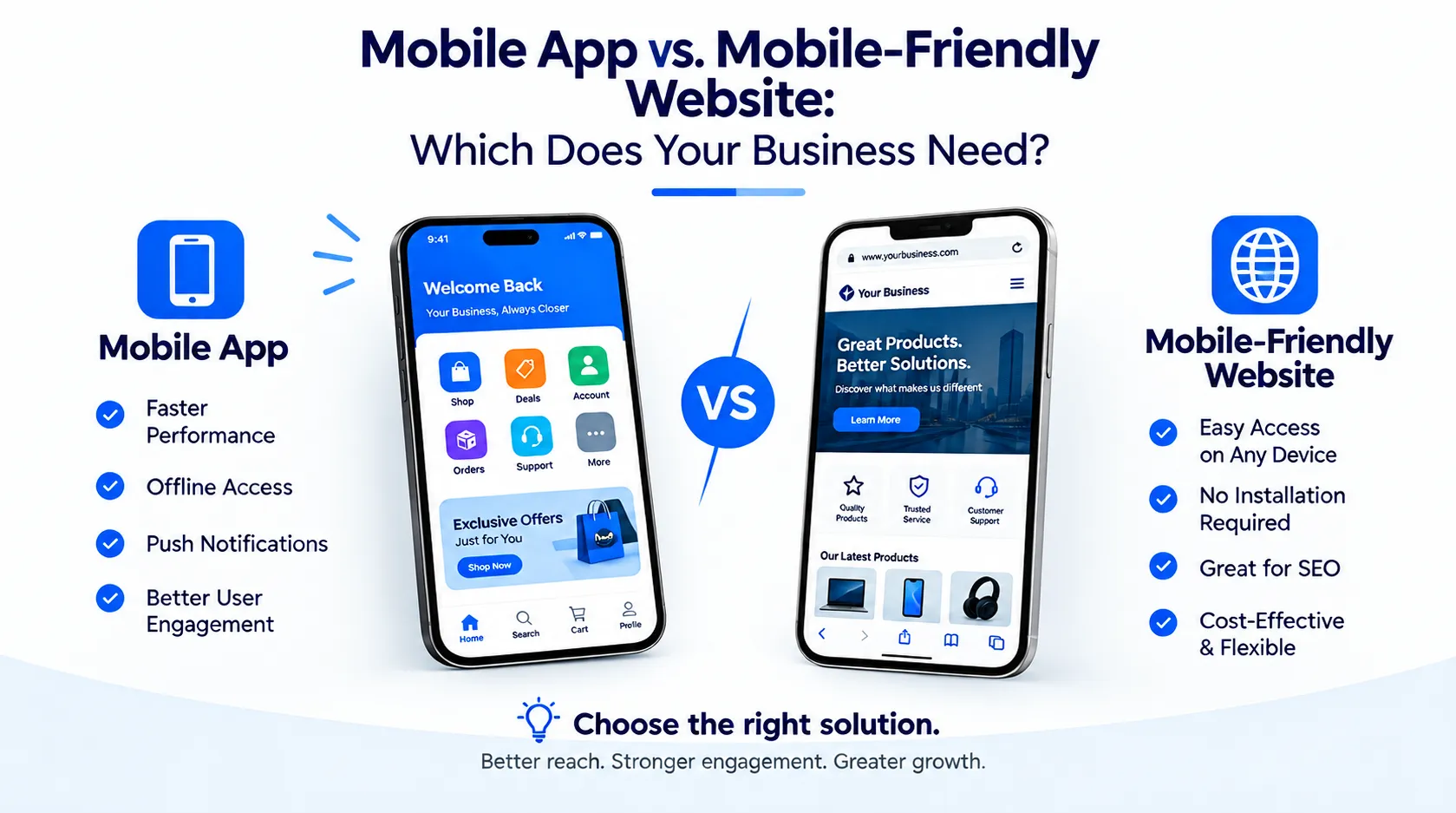
A mobile-friendly website is usually the right starting point for businesses that need a strong mobile presence, while a mobile app makes more sense when customers need frequent, personalized, or feature-rich interactions. Both options serve mobile users, but they solve different business needs.
A mobile-friendly website works through a browser and adapts its layout to different screen sizes. A mobile app is installed on a smartphone and can provide deeper access to device features and personalized experiences.
The right choice depends on your customers, business goals, budget, and the experience you want to create.
What Is a Mobile-Friendly Website?
A mobile-friendly website is a website designed to work smoothly on smartphones and tablets. Its content, navigation, images, buttons, and forms adjust to smaller screens.
Customers can access it through browsers such as Chrome or Safari without downloading anything.
A restaurant, for example, can use a mobile-friendly website to display its menu, location, opening hours, and online ordering options. A service business can use one to show its services, portfolio, contact information, and booking form.
The website gives customers quick access without requiring an app installation.
What Is a Mobile App?
A mobile app is software built specifically for smartphones and tablets to provide a dedicated user experience.
Apps can support features that go beyond standard website browsing. These may include push notifications, device integrations, personalized accounts, offline functionality, location features, camera access, and mobile payments.
For businesses with customers who return frequently, an app can create a more direct connection between the customer and the brand.
What Is the Difference Between a Mobile App and a Mobile-Friendly Website?
The main difference is how customers access and interact with the product. A mobile-friendly website runs inside a browser, while a mobile app is installed directly on the user’s device.
A website is easier to access and share. Someone can click a search result or link and immediately visit the site.
An app requires a download and installation. In return, it can provide a more controlled and personalized experience.
The difference becomes more important when your business needs advanced functionality rather than simple mobile access.
Which Option Is Better for Reaching New Customers?
A mobile-friendly website is generally better for reaching new customers because people can access it directly from search engines, social media, advertisements, and shared links.
A potential customer does not need to install anything before viewing your business.
For example, someone searching for a local fitness studio can find its website through Google, view the services, check pricing, and submit an inquiry from a phone.
This creates a low-friction first interaction.
Which Option Provides a Better Customer Experience?
A mobile app can provide a more personalized experience for customers who interact with your business regularly.
Apps can remember user preferences, account information, previous activity, saved items, and other relevant data.
A retail app, for example, can show personalized products and previous purchases. A food ordering app can save delivery addresses and favorite orders.
A mobile-friendly website can still provide an excellent experience. The difference is that an app gives businesses more control over the dedicated mobile environment.
Is a Mobile App Better for Customer Retention?
A mobile app can support stronger repeat engagement through features such as push notifications, saved preferences, loyalty programs, and personalized content.
Customers who already use an app can open it directly from their phones instead of searching for the business again.
For businesses that depend on repeat purchases, bookings, subscriptions, or frequent customer interactions, this direct access can be valuable.
A website remains useful for bringing new customers into the business. An app can then support ongoing engagement.
Which Is Better for SEO?
A mobile-friendly website is the stronger choice for search visibility because its pages can be indexed and accessed through search engines.
Businesses can create service pages, product pages, location pages, blog content, and other useful resources that attract organic traffic.
A mobile app does not replace this role. An app and website can work together, with the website attracting users and the app serving customers who want a deeper experience.
For businesses investing in organic search, a mobile-friendly website should remain part of the digital strategy.
Which Option Costs Less to Build?
A mobile-friendly website generally requires less development work than a custom mobile app, especially when the business only needs basic mobile functionality.
Website costs depend on design, functionality, content, integrations, ecommerce requirements, and other technical needs.
Mobile app development involves additional considerations such as platform development, app architecture, device compatibility, testing, deployment, maintenance, and updates.
Building an app makes sense when its features provide enough business value to justify the additional investment.
When Does Your Business Need a Mobile-Friendly Website?
A mobile-friendly website is a strong choice when your main goal is to make your business accessible to mobile users.
It works well for businesses that need to:
- Generate leads
- Showcase services
- Publish content
- Sell products
- Receive bookings
- Provide business information
- Attract search traffic
- Build online visibility
For many businesses, a responsive website is the first step toward creating a strong mobile presence.
When Does Your Business Need a Mobile App?
A mobile app becomes more valuable when customers need to interact with your business repeatedly or use features that benefit from a dedicated mobile environment.
An app may suit businesses that need:
- Customer accounts
- Loyalty programs
- Push notifications
- Personalized experiences
- Frequent purchases
- In-app payments
- Real-time updates
- Location-based features
- Device integrations
- Offline functionality
- Complex user workflows
The important question is not whether an app looks more advanced. The question is whether customers have a reason to install and regularly use it.
Can a Business Have Both a Website and a Mobile App?
Yes, many businesses can benefit from having both because each serves a different purpose.
The website can attract new visitors through search engines, social media, advertisements, and direct links.
The app can serve existing customers with personalized features, notifications, saved preferences, and faster repeat interactions.
For example, an ecommerce business can use its website to attract shoppers searching for products online. Customers can then use the mobile app for repeat purchases, order tracking, loyalty rewards, and personalized recommendations.
The two platforms can support the same business without replacing each other.
What Should You Consider Before Choosing?
Start with your customers and their behavior rather than choosing based only on technology.
Ask how frequently customers interact with your business. Consider whether they need personalized accounts, notifications, location services, mobile payments, or other advanced features.
Think about how customers currently find you. Search-driven businesses need a strong website. Businesses built around repeat engagement may gain more value from an app.
Your budget and long-term product roadmap matter too. An app should have a clear purpose beyond simply putting your website inside an app.
Should You Build a Website Before a Mobile App?
For many businesses, building a strong mobile-friendly website first provides a practical foundation before investing in an app.
A website can establish the brand online, attract search traffic, test customer demand, and reveal which services or products receive the most attention.
Once customers show a need for deeper mobile interaction, an app can extend that experience.
This approach can help businesses avoid spending heavily on an application before understanding how customers want to use it.
How Can CoPixels Help With Mobile App Development?
CoPixels Media provides mobile app development services for businesses that need a dedicated mobile product.
Its services cover iOS, Android, Flutter, React Native, and cross-platform mobile development. The process includes strategic ideation, UI/UX design, development, quality assurance, deployment, and ongoing support. (copixels.com)
CoPixels can help businesses evaluate their app idea, plan the user experience, define the required functionality, and develop an application around specific business goals.
The focus should be on creating an app that customers have a real reason to use.
Mobile App or Mobile-Friendly Website: Which Should You Choose?
Choose a mobile-friendly website when accessibility, search visibility, and broad reach are your priorities. Choose a mobile app when repeat engagement, personalization, and advanced mobile features are central to your business.
You do not have to treat them as competing technologies. A website can bring people to your business, while an app can deepen the relationship with returning customers.
The right choice starts with your customer’s needs and your business objectives.
Need help deciding whether your business needs a mobile app? CoPixels Media can help you plan, design, develop, and launch a mobile application built around your goals.
Frequently Asked Questions
Is a mobile app better than a mobile-friendly website?
No. Each serves a different purpose. A website provides broad access, while an app supports deeper mobile interactions.
Can a mobile-friendly website replace a mobile app?
For some businesses, yes. An app becomes more useful when customers need frequent engagement or advanced mobile features.
Does a mobile app help with SEO?
Not in the same way as a website. A website provides indexable pages that can attract organic search traffic.
Should a small business build a mobile app?
A small business should build an app when customers have a clear reason to use it regularly. A mobile-friendly website may be the better first step for basic needs.
Can CoPixels develop both websites and mobile apps?
Yes. CoPixels provides digital development services and mobile app development for businesses that need to build or expand their digital products.





No comment