
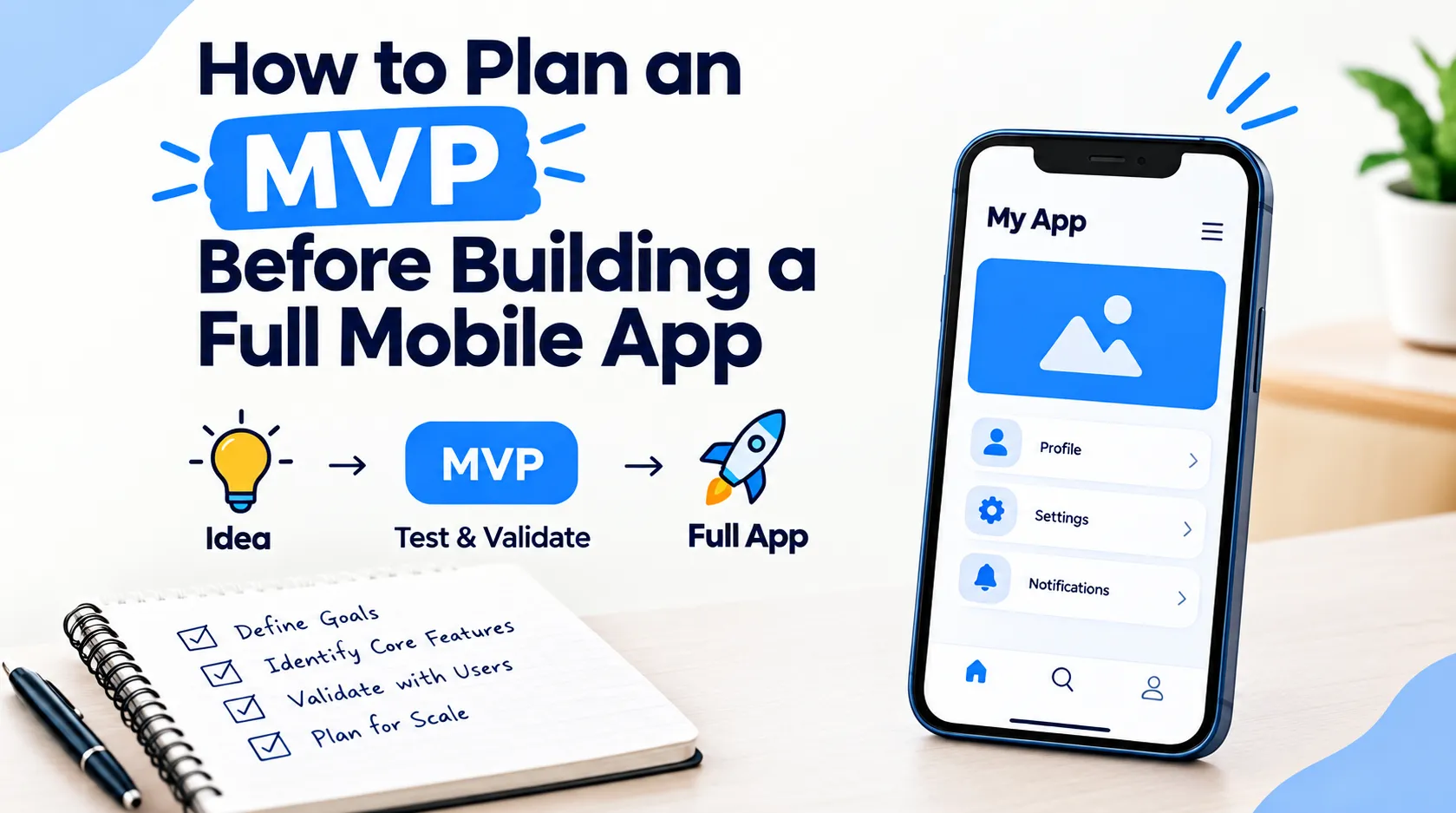
Planning an MVP before building a full mobile app helps you test the core idea, understand user needs, control development costs, and make better product decisions before investing in a larger application. An MVP, or Minimum Viable Product, includes the smallest set of features needed to solve a real user problem and collect useful feedback.
A full mobile app may include dozens of features, integrations, user flows, and design elements. Building everything at once increases the project scope. An MVP gives you a focused starting point. You build what matters first, put it in front of users, study how they respond, and use those insights to guide the next version.
What Is an MVP in Mobile App Development?
A mobile app MVP is an early version of an application built around its most important user problem and core features. It is not an unfinished version of the final app. It is a focused product designed to test the main idea with real users.
For example, imagine a business wants to build a food delivery app. The complete product may include restaurant discovery, advanced filters, loyalty programs, multiple payment options, live delivery tracking, reviews, promotions, subscriptions, and personalized recommendations.
The MVP may start with restaurant listings, menus, ordering, payment, and basic order tracking.
The goal is simple: prove that customers want the core experience before expanding the product.
Why Should You Plan an MVP Before Building the Full App?
An MVP gives your development project a clear direction before you commit to the full product scope. It helps separate essential features from ideas that can wait.
Many app ideas start with a long feature list. Some features sound useful but have not been tested with actual customers. Building all of them from day one adds development work without proving that users need them.
MVP planning puts the core problem first. It asks what the user needs, what the business needs to validate, and which features support that goal.
This approach can make the development process more focused and create a stronger foundation for future updates.
How Do You Define the Main Problem Your App Will Solve?
Start by identifying one specific problem instead of starting with a list of app features.
Ask what users struggle with today. Look at how they currently solve the problem. Then identify where an app can make that experience better.
For example, a fitness business may want an app with workout videos, meal plans, community discussions, challenges, messaging, subscriptions, and progress tracking.
The core problem may simply be that customers need an easier way to follow personalized workouts.
That problem should guide the first version.
Who Is the MVP For?
Your MVP should have a clearly defined target user. Trying to build one product for everyone makes feature planning harder.
Define who will use the app, what they want to accomplish, and what prevents them from doing it today.
A restaurant ordering app, for example, may target existing restaurant customers who want to order directly from their phones. That audience has different needs from restaurant owners using an internal management application.
Clear user definition helps shape the features, interface, navigation, and user journey.
Which Features Should Be Included in the MVP?
The MVP should include features that directly support the main user goal and leave secondary features for later versions.
Start by creating a complete feature list. Then divide the features according to their importance.
Core features belong in the MVP because the app depends on them. Supporting features can be planned for later releases.
For example, a basic marketplace MVP may need:
- Account creation
- Product browsing
- Product details
- Search
- Shopping cart
- Checkout
- Payment
- Order confirmation
Advanced recommendations, loyalty rewards, social sharing, and personalized dashboards may come later.
The right MVP is not the one with the fewest features. It is the one with the smallest feature set that still delivers the intended value.
How Do You Map the User Journey?
Mapping the user journey shows exactly how someone will move through the MVP from the first screen to the desired action.
Consider what happens when the user opens the app.
Do they create an account first? Can they browse without signing up? What happens after they select an item? Where does payment happen? What confirmation do they receive?
These questions reveal missing steps before development begins.
A simple user flow can prevent unnecessary screens and confusing navigation.
Should You Create Wireframes Before Development?
Yes, wireframes help turn the MVP idea into a visual product structure before developers begin coding.
Wireframes show the placement of important elements on each screen. They focus on structure rather than visual decoration.
A prototype can take this further by allowing stakeholders and potential users to move through the planned experience.
CoPixels Media includes user-centered design as part of its mobile app development process, with UI/UX planning used to create intuitive application experiences.
How Do You Choose the Right Technology for an MVP?
Choose the technology based on the MVP’s requirements, target platforms, performance needs, integrations, and future roadmap.
A business may choose native development for iOS or Android when platform-specific capabilities are important. Cross-platform development may make sense when the product needs to reach both platforms from a shared codebase.
CoPixels Media currently offers native iOS and Android development along with Flutter and React Native development for cross-platform applications.
The technology decision should support the product rather than dictate the product.
How Should You Plan the MVP Budget?
Set the MVP budget around the core product rather than the full list of future features.
Development costs depend on factors such as design complexity, platform selection, backend requirements, integrations, security requirements, and the number of features.
A smaller MVP gives the team a clearer scope. It makes it easier to estimate development work and identify where the budget should go first.
The budget should cover more than coding. UI/UX design, backend development, testing, deployment, security, and post-launch improvements all matter to the product.
How Do You Decide What to Build After the MVP?
Use real user feedback and product data to decide which features should come next.
After launch, look at how users interact with the app. Identify where they complete the intended action and where they stop.
User feedback may reveal that an expected feature is not important while another missing feature is highly requested.
This creates a product roadmap based on evidence rather than assumptions.
What Should You Measure After Launch?
Measure whether the MVP is solving the problem it was designed to solve.
Useful measurements depend on the type of application. They may include sign-ups, completed orders, bookings, subscriptions, repeat usage, conversion rates, feature usage, or customer feedback.
For example, an ordering app may track how many users browse a menu, add items to a cart, complete checkout, and return for another order.
The numbers help show which parts of the product deserve attention in the next development cycle.
How Does an MVP Reduce Feature Creep?
An MVP creates a defined starting scope that keeps unnecessary features out of the first development cycle.
Feature creep happens when new ideas continue entering the project during development. One new feature leads to another. The original product becomes larger, slower to develop, and harder to manage.
A clear MVP roadmap gives every feature a place.
Some features belong in version one. Others belong in later releases.
That distinction keeps the first product focused.
What Happens After the MVP Is Validated?
Once the MVP proves its core value, the product can grow through planned feature enhancements, performance improvements, integrations, and broader user support.
The full app should evolve from what the MVP teaches you.
The next version may add advanced search, loyalty programs, subscriptions, AI personalization, third-party integrations, additional payment methods, or other features based on actual product needs.
CoPixels Media provides ongoing support, performance monitoring, feature enhancements, and scaling as mobile applications grow.
How Can CoPixels Media Help Plan and Build Your MVP?
CoPixels Media can help turn an app idea into a structured mobile product plan and take the project from concept through development, testing, launch, and ongoing improvement.
Its mobile app development services cover iOS, Android, React Native, Flutter, and cross-platform solutions. The development process includes strategic ideation, user-centered design, development, quality assurance, deployment, and ongoing support.
The team can help define the product concept, map the user experience, select the right development approach, build the core application, test the product, and prepare it for launch.
The goal is not to build every possible feature at once. It is to build the right first version and create a foundation for future growth.
Start Your Mobile App With a Focused MVP
A strong mobile app starts with a clear product idea and a focused development plan. Planning an MVP before building the full application gives you a practical way to test your concept, prioritize features, understand users, and plan future development.
CoPixels Media provides full-cycle mobile app development services for businesses that need help moving from an initial concept to a functional, scalable application. Contact CoPixels Media to plan your MVP and build a mobile app around real user needs.
Frequently Asked Questions
Is an MVP the same as a complete mobile app?
No. An MVP contains the core features needed to test the main product idea. More features can be added after launch.
How many features should an MVP have?
There is no fixed number. The MVP should include enough features to solve the main user problem and deliver the intended experience.
Should I build an MVP for both iOS and Android?
It depends on your target audience, budget, and product strategy. Native or cross-platform development can be considered based on those requirements.
Can an MVP be redesigned after launch?
Yes. User feedback and product data can guide UI improvements, new features, and changes to the user experience.
Can CoPixels Media build the full app after the MVP?
Yes. CoPixels Media provides mobile app development and ongoing feature enhancement services that support the product beyond its initial release.

No comment