
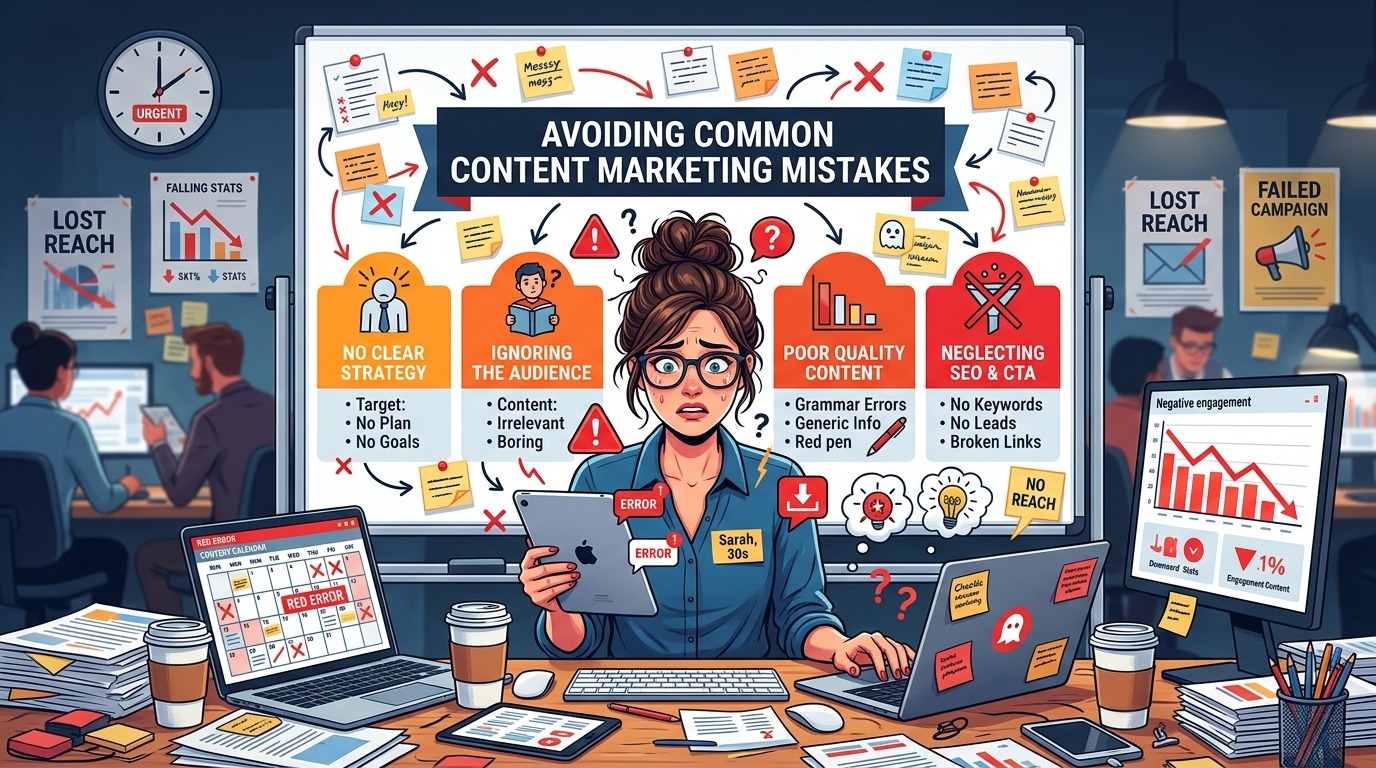
Content marketing becomes expensive when businesses create content without knowing what it needs to accomplish. Publishing more blogs, social posts, or promotional pages does not automatically create more traffic or customers. The biggest waste usually comes from creating the wrong content, targeting the wrong intent, or failing to connect content with a clear business goal.
Here are five content marketing mistakes that can drain your budget while producing little value.
1. Creating Content Without a Clear Strategy
The first mistake is publishing content simply because the business needs “something new.”
A blog calendar filled with random topics does not create a content strategy. Every piece should have a reason to exist. It should answer a customer question, support a service, build topical relevance, attract search traffic, or move a potential customer toward the next step.
For example, a restaurant may publish articles about general food trends while missing searches directly related to its menu, location, ordering options, and customer needs.
A clear strategy starts with the audience, search intent, business goals, and topics the brand needs to own. This gives individual pages a role within the larger website instead of leaving them as isolated pieces of content.
2. Chasing Keywords Instead of Search Intent
Keywords matter, but a keyword by itself does not tell you what a customer actually wants.
Someone searching for “restaurant website design” may be researching the topic, comparing agencies, or looking for a service provider. Someone searching for “how much does a restaurant website cost” has a different need.
Creating content around the same phrase without understanding the intent behind it leads to weak pages that do not satisfy the searcher.
Good content addresses the question behind the query. It explains the subject clearly, covers the important related concepts, and gives the reader the information needed for that stage of the decision.
The goal is not to repeat a keyword throughout a page. The goal is to create a useful resource that matches what the searcher is trying to accomplish.
3. Publishing Content Without Supporting the Website
A business can publish dozens of articles and still have a weak content ecosystem.
The problem appears when blog posts have no meaningful connection to the services, products, or important pages on the website. A visitor reads one article and has nowhere useful to go next.
Internal linking helps establish relationships between related pages. A blog about restaurant online ordering, for example, can naturally connect to a relevant online ordering service page. A page about local SEO can support broader SEO content and related business services.
This creates a path through the website.
Content should not exist as a collection of separate articles. It should contribute to the structure and authority of the entire site.
4. Focusing on Quantity Over Quality
Publishing ten weak articles does not necessarily create more value than publishing two genuinely useful ones.
Thin content, repetitive topics, generic advice, and pages written only to reach a word count can consume a budget without giving customers a reason to stay.
Quality content answers the subject directly and provides enough context to make the answer useful. It uses clear examples, logical structure, relevant entities, and information that matches the reader’s needs.
This does not mean every article needs to be extremely long.
A focused 900-word article that answers a specific question well can be more useful than a 2,500-word article filled with repetition.
The better question is not, “How much content did we publish?”
It is, “What did this content accomplish?”
5. Creating Content Without Measuring What Happens Next
Publishing a piece of content is not the end of the process.
Businesses need to understand how people interact with their content. Search traffic, engagement, conversions, landing-page behavior, and other relevant metrics provide clues about what is working and what needs improvement.
A page receiving traffic but generating no meaningful action may need a stronger connection to the next step. A page with little search visibility may need better topic coverage, stronger internal linking, or a different search intent.
Measurement turns content marketing from a publishing exercise into an ongoing process.
Without it, businesses can continue spending money on the same types of content without knowing whether those investments are helping.
How Can Businesses Avoid Wasting Their Content Marketing Budget?
The solution is not simply to spend more on content.
Start by defining what the content needs to achieve. Then research the audience and search behavior, map topics to the right pages, create useful content, connect related pages, and measure the results.
Content marketing works best when every part has a role.
A service page can target commercial intent. A supporting article can answer an informational question. Internal links can connect the two. Social content can bring additional attention to the topic. Analytics can show what happens after visitors arrive.
That is a system, not a pile of blog posts.
Is Your Content Budget Working Hard Enough?
Content should earn its place on your website.
When topics are chosen strategically, content can support organic visibility, answer customer questions, strengthen important service pages, and help potential customers move closer to a decision. When content is created without direction, the same budget can disappear into articles that receive little attention or produce no meaningful business outcome.
Copixels helps businesses build digital marketing strategies around their audience, search visibility, website goals, and broader online presence. The focus is not simply on producing more content. It is on creating content that has a clear purpose within the business.
Want to get more from your content marketing budget? Talk to Copixels about building a content strategy around your business goals.
Frequently Asked Questions
How much should a business spend on content marketing?
There is no single budget that fits every business. The right investment depends on goals, competition, audience, and the amount of content required.
Does every business need a blog?
No. A business needs content that supports its audience and goals. A blog is one part of a broader content strategy.
How often should a business publish new content?
Publishing frequency should follow the business’s content opportunities and available resources rather than an arbitrary posting target.
Should old website content be deleted?
Not automatically. Existing content should be evaluated for relevance, performance, accuracy, and its role within the website before removal.
What is the most important content marketing metric?
The most useful metric depends on the goal of the content. Traffic, engagement, leads, conversions, and search visibility can each matter at different stages.


No comment