
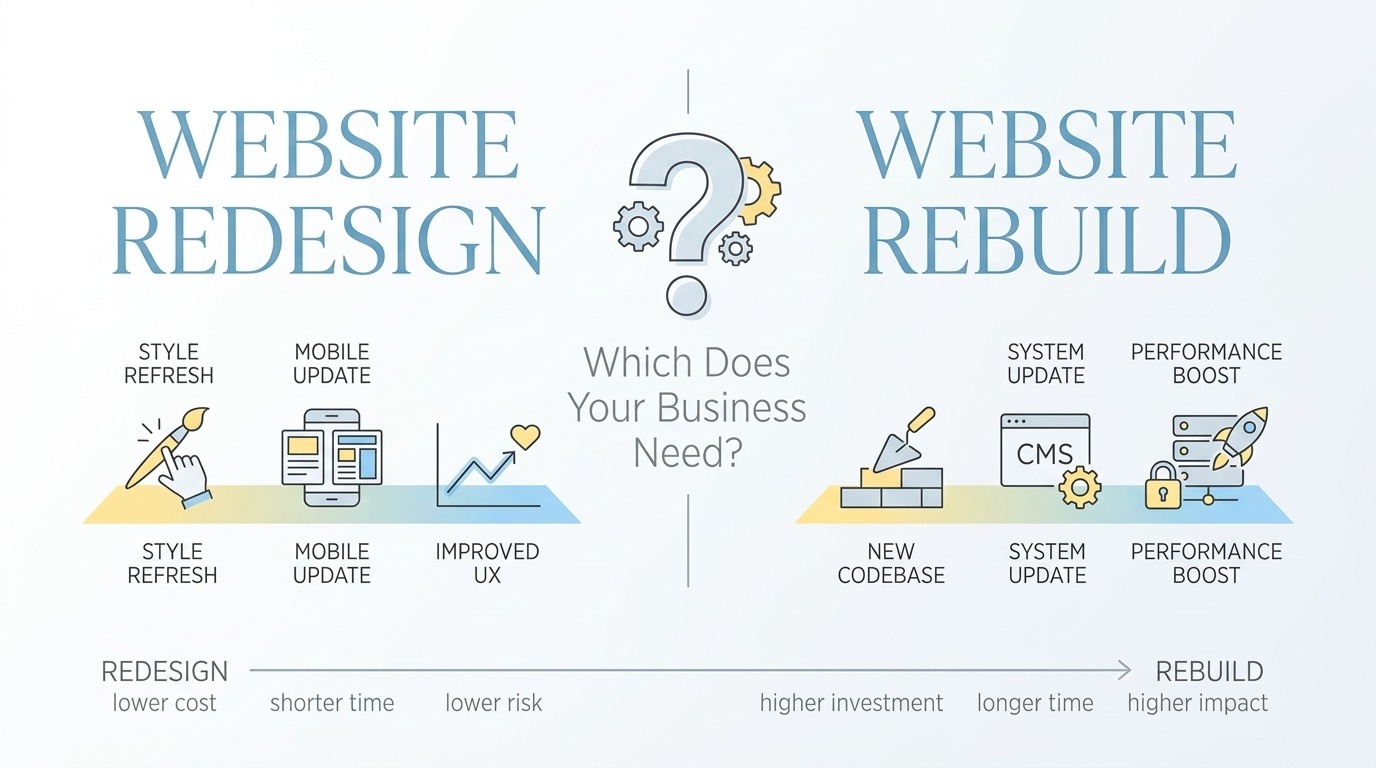
A website redesign vs. website rebuild can be confusing. A redesign improves appearance and usability, while a rebuild replaces the entire structure. A website redesign improves the appearance, usability, and structure of an existing website, and website rebuild replaces the underlying website structure, technology, or code. The right choice depends on what is holding your current website back. A dated design calls for a redesign, but serious performance, functionality, security, or technical problems often require a rebuild.
The difference matters because changing the look of a website will not fix a weak foundation. Likewise, rebuilding an entire website makes little sense when the existing structure works well and only needs a visual and user experience upgrade.
What Is a Website Redesign?
A website redesign changes how an existing website looks and works without necessarily replacing its entire technical foundation.
The focus is usually on the user experience, visual design, navigation, content presentation, mobile layout, and conversion path. A business may keep its existing CMS, hosting setup, URLs, database, and much of its code while improving the parts visitors interact with.
For example, a business website may have a solid technical structure but look outdated on mobile devices. A redesign can introduce a cleaner layout, better typography, clearer calls to action, improved navigation, and stronger service pages.
The goal is simple: make the existing website work better for the people using it.
What Is a Website Rebuild?
A website rebuild goes deeper by replacing or restructuring the technical foundation of a website.
A rebuild becomes relevant when the existing system creates problems that design changes cannot solve. The website may rely on outdated technology, have poorly organized code, lack important functionality, load slowly because of its underlying structure, or make future development difficult.
A rebuild can involve a new CMS, redesigned database structure, new codebase, updated integrations, improved architecture, or a move to a different development framework.
The visible website may look similar after the rebuild, but the technology behind it is substantially different.
How Do You Know Your Business Needs a Redesign?
A redesign is the better direction when your website still has a workable foundation but no longer represents the business well.
An outdated visual identity is one clear sign. Customers form an impression quickly, and an old-looking interface can make a business appear less established than it actually is.
Poor navigation is another reason to redesign. Visitors should understand where to go next without searching through confusing menus or excessive pages.
A redesign makes sense when the website has useful content and functioning technology but needs improvements such as better mobile layouts, clearer calls to action, stronger page structure, or a more current visual style.
The key question is: Does the existing website work underneath the surface, but need a better presentation and user experience?
When the answer is yes, redesigning may be enough.
When Is a Website Rebuild the Better Choice?
A rebuild is more appropriate when the problems go beyond appearance.
An outdated CMS or development framework can limit what the website does. Broken integrations, difficult maintenance, poor scalability, security concerns, and a complicated codebase can create problems that a visual redesign cannot address.
A rebuild is worth considering when adding a new feature requires excessive development work or when the existing website has become difficult for developers to maintain.
It is especially relevant for businesses that have changed significantly since their original website was built. A company may have new services, new customer journeys, e-commerce requirements, booking systems, CRM integrations, or other functions that the old architecture was never designed to support.
In that situation, rebuilding creates a foundation that matches the business as it operates today.
What Is the Difference Between a Redesign and a Rebuild?
The main difference is depth.
A redesign primarily changes the website’s presentation and user experience. A rebuild changes the underlying structure that makes the website function.
Think of it like a house. A redesign is closer to updating the interior, improving the layout, replacing fixtures, and giving the space a new look. A rebuild addresses the structure itself.
Some projects need both. A business may rebuild the technical foundation and then redesign the interface around the new system.
Can a Website Redesign Improve SEO?
Yes. A well-planned redesign can support SEO by improving site structure, mobile usability, page experience, internal linking, content organization, and navigation.
The important part is protecting the SEO value that already exists.
Changing URLs without proper redirects, removing useful pages, altering content without a strategy, or overlooking metadata can create unnecessary search visibility problems. A redesign should therefore consider both users and search engines before changes go live.
The best redesign is not simply a prettier website. It gives visitors clearer paths while preserving and improving the site’s search structure.
Does a Website Rebuild Affect SEO?
A rebuild can have a larger SEO impact because it may change URLs, page structures, technology, navigation, and content organization.
That makes planning especially important.
Existing high-value pages should be identified before development begins. URL changes need appropriate redirects, important content should not disappear without a reason, and technical SEO elements should be reviewed during the rebuild.
A technically stronger website does not automatically rank better. Its new structure still needs to communicate clear relationships between the business, its services, locations, topics, and individual pages.
Should You Redesign or Rebuild Your Business Website?
Start with the problem rather than the terminology.
A redesign fits a website that has a sound foundation but needs a better appearance, user experience, navigation, mobile presentation, or conversion structure.
A rebuild fits a website where the underlying technology, architecture, functionality, or maintenance has become a problem.
There is no advantage in rebuilding a website simply because it looks old. There is equally little value in giving an attractive new design to a website whose technical foundation is holding the business back.
The right project solves the actual problem without creating unnecessary work.
What Should You Check Before Making the Decision?
Look at the website from both the customer’s side and the technical side.
Ask whether visitors find the information they need quickly. Check whether the site works properly on mobile devices. Review page speed, navigation, forms, integrations, content structure, analytics, search visibility, and the ease of making future updates.
Then look at the business itself.
Has the company changed its services? Has the target audience changed? Does the current website support the way customers now interact with the business? Are new features becoming difficult to add?
These answers reveal whether the problem is mainly presentation or foundation.
Make the Website Fit the Business
Your website should support the way your business operates, not force the business to work around an outdated website.
Copixels helps businesses plan and develop websites around their goals, customers, content, and digital requirements. From improving an existing website to building a new digital foundation, the right approach starts with understanding what needs to change and why.
Ready to evaluate your website? Talk to Copixels about the right approach for your next website project.
Frequently Asked Questions
How long does a website redesign take?
The timeline depends on the number of pages, design changes, content, and required functionality.
Is a website rebuild more expensive than a redesign?
A rebuild involves deeper technical work, so it generally requires a larger development scope than a visual redesign.
Can I keep my existing domain during a rebuild?
Yes. A rebuild does not require changing the domain name.
Should website content be changed during a redesign?
Content should be reviewed based on its usefulness, search value, accuracy, and role in the customer journey.
Can a redesign add new website features?
Yes. A redesign can include new functionality when the existing technical foundation supports it.


No comment