
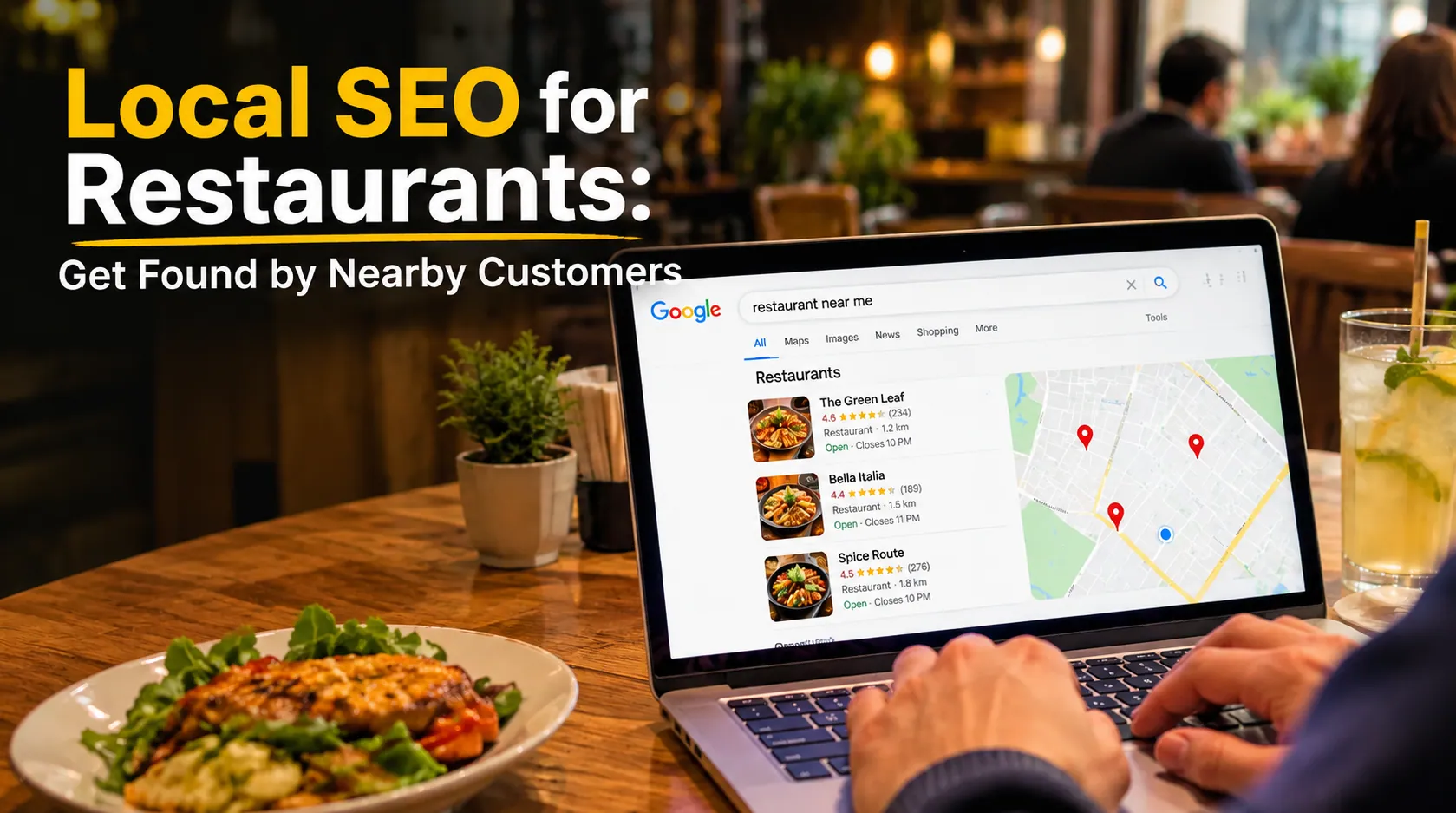
A restaurant can have great food, fair prices, and a beautiful dining space, but none of that matters when nearby customers cannot find it online. Local SEO helps restaurants appear when people in their area search for places to eat, specific dishes, or restaurants near them. It connects your restaurant with people who are already looking for what you sell.
For example, someone searching Google for “Italian restaurant near me,” “best burgers in [city],” or “restaurants open now” has a clear intention to eat. A strong local SEO strategy helps your restaurant become visible during that decision-making moment.
For restaurants, this visibility matters because local search is closely connected to real-world visits, phone calls, reservations, directions, and online orders.
What Is Local SEO for Restaurants?
Local SEO is the process of optimizing a restaurant’s online presence so it appears in searches connected to a specific geographic area.
It goes beyond adding a city name to a website. Local SEO involves your Google Business Profile, restaurant website, reviews, business information, local content, online directories, location signals, and overall search visibility.
Google explains that local search results are mainly influenced by relevance, distance, and prominence. Relevance measures how well a business matches the search, distance considers how close it is to the searcher, and prominence reflects how well-known the business is.
That makes local SEO particularly valuable for restaurants because customers usually want food that is available within a reasonable distance.
Why Does Local SEO Matter for Restaurants?
Restaurant customers rarely search with only a restaurant’s exact name.
They search based on what they need at that moment.
Someone may type:
- “Mexican restaurant near me”
- “best pizza near me”
- “restaurants open late”
- “breakfast restaurant in [city]”
- “halal restaurant near me”
- “Chinese food near me”
- “best restaurant for dinner”
- “restaurant with outdoor seating”
These searches give restaurants an opportunity to reach customers who may have never heard of their brand.
That’s the real value of local SEO. You are not waiting for customers to remember your restaurant. You are helping them find you while they are actively searching for food.
How Does Google Help Customers Find Local Restaurants?
Google uses information from Business Profiles, websites, users, third-party sources, and other publicly available information to provide local search results.
A restaurant’s Google Business Profile can show important details such as:
- Restaurant name
- Address
- Phone number
- Opening hours
- Website
- Menu
- Photos
- Customer reviews
- Directions
- Restaurant category
- Services and attributes
This information gives potential customers the details they need before deciding where to eat.
A complete and accurate profile is important because Google says businesses with complete and accurate information are more likely to appear in relevant local searches.
How Does Google Business Profile Improve Restaurant Visibility?
A Google Business Profile is one of the most important parts of restaurant local SEO.
When someone searches for a nearby restaurant, the profile can appear in Google Search and Google Maps. Customers can quickly see where the restaurant is, when it opens, what it looks like, and what other customers think about it.
Restaurant owners should keep their profile accurate and regularly maintained.
That means updating:
- Business hours
- Holiday hours
- Address
- Phone number
- Website
- Restaurant category
- Menu information
- Photos
- Services
- Customer reviews
Accurate information reduces friction. A customer should not have to visit three different websites just to determine whether your restaurant is open.
Why Do Restaurant Reviews Matter for Local SEO?
Reviews influence both customer decisions and local visibility.
Think about two restaurants competing for the same customer. One has a handful of reviews with little recent activity. The other has hundreds of genuine customer reviews and regularly responds to feedback.
The second restaurant immediately has more social proof.
Google states that review count and positive ratings can help a business’s local ranking.
Restaurants should encourage genuine customers to leave reviews and respond to reviews professionally.
The goal is not to collect meaningless ratings. The goal is to build a trustworthy online reputation that reflects the actual customer experience.
How Does Restaurant Website SEO Support Local Search?
Your Google Business Profile is important, but your website still plays a major role.
A restaurant website should clearly communicate:
- What type of food you serve
- Where the restaurant is located
- Which areas you serve
- Your menu
- Opening hours
- Contact information
- Online ordering options
- Reservation options
- Restaurant specialties
- Important services or dining options
Location-specific pages and useful local content can help search engines understand the connection between your restaurant, your services, and your geographic market.
For example, a restaurant in Connecticut might create useful pages around searches such as “Italian restaurant in Bristol” or “pizza delivery in Bristol,” provided those topics accurately represent the restaurant’s services.
The key is relevance. Do not create dozens of city pages simply to rank for locations you do not actually serve.
Why Does Mobile SEO Matter for Nearby Restaurant Searches?
Restaurant searches often happen when people are away from home.
They may be walking through a shopping area, driving to dinner, sitting at work, or deciding where to order lunch.
That makes mobile usability critical.
A restaurant website should load quickly and make important actions easy to find. Customers should be able to:
- View the menu
- Get directions
- Call the restaurant
- Place an order
- Make a reservation
- Check opening hours
A slow or confusing mobile website can turn a high-intent search into a lost customer.
How Does Local Content Attract Nearby Customers?
Local content gives restaurants another way to appear in relevant searches.
Instead of publishing generic food articles that every restaurant could write, create content connected to your actual customers and location.
Examples include:
- Best dishes to try at a local restaurant
- Where to find the best lunch near [location]
- Family-friendly dining options in [location]
- Best foods for a weekend dinner
- Guide to ordering takeout in [location]
- What to order for a group dinner
- Best restaurant meals for office lunches
This type of content can support broader restaurant SEO while giving potential customers useful information.
The important part is keeping the content genuinely useful. Local SEO should help people make decisions, not simply give search engines more pages to crawl.
How Do Local Citations Help Restaurants?
Local citations are online mentions of a restaurant’s business information, such as its name, address, and phone number.
These mentions may appear on:
- Local directories
- Food websites
- Restaurant directories
- Chamber of commerce websites
- Review platforms
- Local publications
- Community websites
Consistent business information helps reinforce the restaurant’s identity across the web.
Google says it may use information from public websites, third parties, users, and other sources when compiling Business Profile information.
That is why restaurants should keep their core business information accurate wherever the restaurant is listed.
How Can Restaurants Use Local Keywords Without Keyword Stuffing?
Local keywords help describe what your restaurant offers and where you offer it.
But repeating the same phrase in every paragraph does not create a better customer experience.
Instead, use natural language.
For example, a pizza restaurant could naturally mention:
- Pizza restaurant in Bristol
- Pizza delivery in Bristol
- Italian food in Bristol
- Takeout pizza near Bristol
- Family pizza restaurant
- Fresh pizza for local customers
The content should answer the customer’s question first.
Search engines are getting better at understanding meaning, entities, context, and search intent. A restaurant website should therefore focus on clearly explaining the business rather than forcing the same keyword into every sentence.
Why Do Restaurant Photos Matter in Local Search?
People eat with their eyes first.
Photos of your restaurant, dishes, dining room, staff, and menu items give potential customers a reason to choose you.
Google recommends adding photos and videos to a Business Profile because they help businesses show customers what they offer and tell their story.
For restaurants, strong visuals can make a major difference.
A customer comparing several nearby restaurants may choose the one with appealing food photography, a welcoming dining room, and clear information about what to expect.
How Can Local SEO Turn Searches Into Restaurant Orders?
Visibility is only the first step.
Once a customer finds your restaurant, the next step should be obvious.
Your online presence should make it easy to:
Find → Evaluate → Choose → Order or Visit
For example:
A customer searches “burgers near me.”
They see your restaurant in local results.
They check your reviews and food photos.
They visit your website.
They view the menu.
They place an order directly or get directions to the restaurant.
That’s a much shorter customer journey than forcing someone to search through multiple websites to find basic information.
For restaurants, this is where local SEO and a strong restaurant website work together.
What Should Restaurants Do to Improve Local SEO?
Restaurants looking to improve local visibility should start with the fundamentals:
- Claim and verify the Google Business Profile.
- Keep business information accurate and complete.
- Use the correct restaurant category and relevant attributes.
- Add high-quality food and restaurant photos.
- Keep opening hours updated.
- Build genuine customer reviews and respond to them.
- Optimize the restaurant website for local search intent.
- Make the website fast and mobile-friendly.
- Maintain consistent business information across directories.
- Publish useful content relevant to the restaurant and its local customers.
- Make menus, ordering, reservations, phone calls, and directions easy to access.
- Track local search performance and improve based on actual results.
Local SEO is not about one trick that suddenly puts a restaurant at the top of Google. It is about building a consistent online presence that clearly tells search engines and customers who you are, what you offer, and where you serve.
Why Should Restaurants Invest in Local SEO?
A restaurant’s most valuable customers are often close to the restaurant.
Someone searching from the other side of the country is unlikely to become a dinner customer tonight. Someone searching “restaurant near me” three miles away is a completely different prospect.
Local SEO puts your restaurant in front of people who are geographically close and actively looking for food.
That makes local search one of the most practical parts of a restaurant’s digital marketing strategy.
At Copixels Media, restaurant marketing goes beyond simply building a website. The company provides restaurant-focused digital solutions that combine restaurant websites, online ordering, SEO and local marketing, professional menu presentation, customer retention, and direct sales strategies.
The goal is simple: help restaurants become easier to find online and make it easier for customers to order directly.
Frequently Asked Questions
How long does local SEO take to work for a restaurant?
Local SEO usually takes time because rankings depend on factors such as relevance, distance, prominence, competition, website quality, reviews, and the strength of the restaurant’s overall online presence. A restaurant should treat local SEO as an ongoing marketing process rather than a one-time setup.
Is Google Business Profile enough for restaurant SEO?
No. A Google Business Profile is important, but it works best alongside a well-optimized restaurant website, accurate business information, genuine reviews, useful content, strong local signals, and a good customer experience.
Can a new restaurant rank in local search?
Yes. A new restaurant can build local visibility by creating and verifying its Business Profile, providing complete business information, optimizing its website, collecting genuine customer reviews, and building relevance and prominence over time.
Does local SEO help restaurants get online orders?
Yes. Local SEO can bring potential customers to a restaurant’s website, where they can view the menu and take actions such as ordering food. The restaurant website needs a clear ordering process to turn that search visibility into orders.
Can local SEO help a restaurant compete with large food delivery platforms?
Yes, although it does not guarantee higher rankings than major platforms. Local SEO gives restaurants a way to build their own visibility and direct customers toward their website and ordering system instead of depending entirely on third-party marketplaces.







No comment