
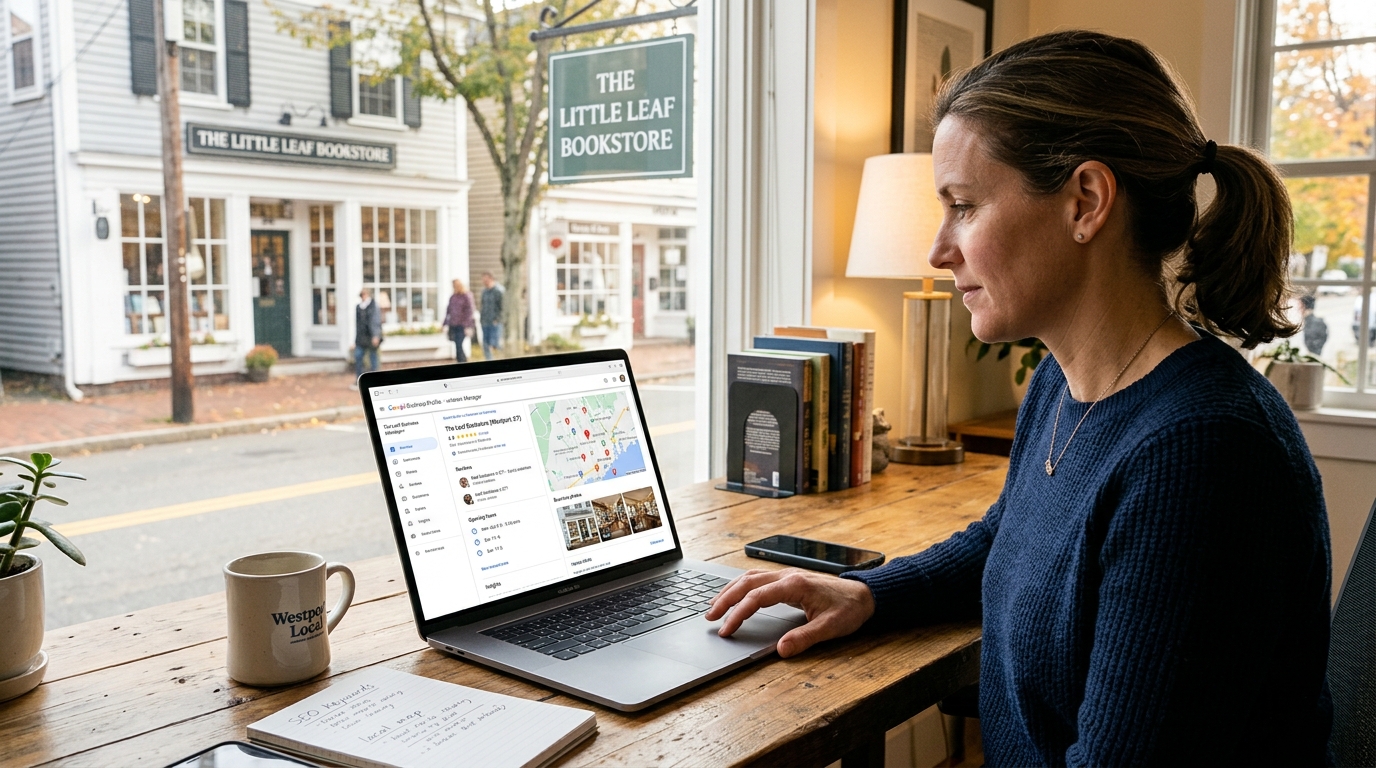
Google Business Profile optimization helps Connecticut businesses appear in relevant Google Search and Google Maps results. A complete profile, accurate business information, relevant categories, customer reviews, and a well-optimized website help customers find and choose your business. For companies in Bristol, Hartford, Waterbury, New Britain, and other Connecticut communities, a strong profile is an important part of local SEO.
However, filling out your profile is only the starting point. Your business needs accurate information, useful content, a consistent online presence, and a plan for turning local searches into customers. CoPixels helps Connecticut businesses improve their Google Business Profile, strengthen local search visibility, and connect their online presence with real business goals.
What Is Google Business Profile Optimization?
Google Business Profile optimization is the process of improving your business listing so customers can understand your services, location, operating hours, and contact details. It helps Google match your business with relevant local searches.
Google Business Profile, formerly Google My Business, connects your business information with Google Search and Google Maps. Customers use it to check opening hours, read reviews, view photos, find directions, and contact local businesses.
For example, a homeowner searching for a roofing contractor in Bristol wants to find a relevant company, review its reputation, and request an estimate. An optimized profile provides the information needed to take that next step.
A strong Google Business Profile supports local SEO alongside your website, customer reviews, local citations, and relevant service pages. These elements help customers understand what your business offers and where it operates.
Why Does Google Business Profile Optimization Matter for Connecticut Businesses?
Google Business Profile optimization matters because local customers often search for a service before contacting a business. Your profile gives them a direct way to evaluate your company without visiting your website first.
Consider a restaurant in Hartford, a plumber in Southington, or a retail store in Waterbury. Each business competes for attention from customers looking for specific products or services nearby. An incomplete profile leaves important questions unanswered.
An optimized profile helps customers find your phone number, check business hours, view recent photos, read customer feedback, and request directions. These actions support the customer journey from discovery to contact.
Google explains that local search results are primarily influenced by relevance, distance, and prominence. Relevance measures how well a business matches a search. Distance relates to the searcher’s location. Prominence reflects how well-known the business is, including signals such as reviews and links from other websites.
Businesses cannot purchase better organic local rankings directly from Google. The practical approach is to improve the information, reputation, and online signals that help Google understand the business.
How Do You Optimize a Google Business Profile in 2026?
Effective Google Business Profile optimization starts with accurate business information and continues through category selection, service details, reviews, photos, and performance tracking. Every element should reflect the real business and help customers make informed decisions.
1. Claim and Verify Your Google Business Profile
Claiming and verifying your Google Business Profile establishes your ability to manage the business listing. Verification helps Google confirm that you are authorized to represent the business.
Start by searching for your company on Google Search and Google Maps. Check whether a profile already exists before creating another one. Duplicate profiles create confusion and may violate Google’s guidelines.
Complete Google’s available verification process, then review the business name, address, phone number, website, and operating hours. Make sure the profile belongs to the correct business location.
Your business name must match its real-world branding. Do not add extra keywords, city names, or service phrases to the name simply to improve rankings. Such changes can violate Google’s Business Profile guidelines.
2. Choose the Right Primary and Secondary Categories
Your Google Business Profile categories tell Google what your business does. The primary category is especially important because it describes the main type of business you operate.
Choose the most specific available category that accurately represents your core service. Add secondary categories only when they describe genuine parts of your business.
For example, a plumbing company should select an appropriate plumbing category rather than adding unrelated categories for electrical work, construction, and home improvement. A restaurant should select a category that reflects its actual restaurant type.
Category selection should follow customer intent and business reality. Adding as many categories as possible does not improve optimization. Accurate categorization helps Google connect your profile with relevant searches.
3. Complete Your Business Information
Complete business information helps customers understand your company and contact you without unnecessary effort. Missing details can create uncertainty and lead potential customers to another business.
Review your business name, address, phone number, website URL, regular hours, holiday hours, and available business attributes. Keep these details current whenever something changes.
Your name, address, and phone number are commonly called NAP information. Consistency across your Google Business Profile, website, and relevant business directories supports accurate business identification.
A company serving customers at its premises should display its eligible business address. A service-area business, such as a mobile plumber, should configure its profile according to Google’s service-area rules. Businesses that do not serve customers at their registered address should not display that address as a public storefront.
4. Optimize Your Business Description
Your business description should explain what you do, who you serve, and what makes your company relevant to local customers. Keep it clear, specific, and focused on real business information.
For example, a Connecticut HVAC company can describe its heating, cooling, installation, and maintenance services, along with the communities it serves. A restaurant can explain its cuisine, dining options, and other useful details.
Avoid turning the description into a list of keywords. Do not add promotional claims, excessive location names, or unsupported statements about being the best business in Connecticut.
The goal is to communicate your value in natural language. Your description should help customers understand the business rather than read like an advertisement written for a search engine.
5. Add Accurate Services and Products
Your services and products help customers understand what they can purchase or book. Detailed information makes your profile more useful and supports the connection between your business and relevant search intent.
A home service provider can list genuine offerings such as drain cleaning, water heater installation, and leak detection. A salon can list haircuts, coloring, and styling services. Eligible retailers can use Google’s product features to showcase available products.
Keep service names and descriptions specific. Explain what each service includes without repeating the same keywords across every entry.
Your Google Business Profile and website should support each other. A service listed on your profile should correspond to a genuine offering on your website. Relevant service pages can provide additional information about pricing, processes, locations, and customer questions.
6. Upload High-Quality Photos and Videos
Photos help customers see your business before visiting or contacting you. They provide visual evidence of your premises, products, team, completed projects, and services.
For Connecticut businesses, useful photos depend on the industry. Contractors can share completed projects and work examples. Restaurants can feature actual dishes and dining areas. Retailers can showcase their storefronts and products.
Use genuine, clear images that accurately represent your business. Keep photos current when your location, team, services, or offerings change.
Avoid stock images that misrepresent your company. Do not add text-heavy graphics in place of real business photos. Visual content should help customers understand what they can expect.
7. Build a Consistent Customer Review Strategy
Customer reviews influence how people evaluate local businesses. They provide insight into customer experiences and contribute to the prominence signals Google considers in local search.
Create a simple process for asking genuine customers to share honest feedback. You can request a review after completing a project, delivering an order, or providing a service. Use Google’s approved review link or other permitted methods.
Respond to positive and negative reviews professionally. Thank customers for useful feedback, address legitimate concerns, and offer an appropriate way to resolve specific problems.
Never purchase fake reviews, offer incentives in exchange for positive reviews, or pressure customers to change negative feedback. These practices undermine trust and can violate Google’s policies.
A review strategy should focus on authentic customer experiences. A steady record of genuine feedback provides more value than a sudden increase in questionable reviews.
8. Publish Relevant Google Business Profile Updates
Google Business Profile posts allow eligible businesses to share updates, offers, events, and other relevant information. These updates give customers another reason to engage with the profile.
A Connecticut restaurant can announce a seasonal menu. A contractor can share a completed project. A retailer can highlight a new product line or an upcoming event.
Publish information that customers will find useful. Use clear descriptions, relevant images, and a suitable call to action when appropriate.
Posting on a fixed schedule is a useful way to maintain fresh business information. However, frequent posting alone does not guarantee better rankings. The content should support customer needs and broader local marketing goals.
9. Improve Your Website’s Local SEO
Your Google Business Profile should connect to a website that reinforces your services, business identity, and service locations. A well-optimized listing cannot compensate for a website that is difficult to use or lacks important information.
Start with your main service pages. Explain what you offer, who you serve, and how customers can contact you. Add relevant location information where it helps users understand your coverage.
A contractor serving Hartford, Bristol, and New Britain can create useful service-area content that addresses real customer needs in those communities. Each page should provide meaningful local information rather than repeating the same text with a different city name.
Review your website’s page titles, headings, internal links, mobile usability, loading performance, and contact information. Structured data, such as LocalBusiness schema where appropriate, can help search engines interpret business details. It does not guarantee enhanced search visibility.
Local citations from relevant directories and industry organizations can reinforce your business information. Relevant backlinks, useful local content, and a trustworthy website further support your broader local SEO strategy.
10. Track Performance and Improve Your Strategy
Google Business Profile optimization should be measured against meaningful business outcomes. Rankings matter, but they do not tell the whole story.
Use the performance data available in your Business Profile to review customer interactions. Depending on the features available, you can examine profile views, searches, website clicks, calls, direction requests, and other engagement metrics.
Google Search Console can help you understand your website’s search visibility and organic search clicks. Google Analytics can help measure website engagement and conversions. Call tracking and form tracking can provide additional insight into lead generation.
Review performance over time rather than reacting to a single week’s results. Changes in demand, competition, distance, and search behavior can affect local visibility.
A useful report connects activity with business outcomes. For example, it should help you understand whether profile visitors are contacting your company, whether service pages attract relevant traffic, and which locations generate qualified leads.
What Are the Most Common Google Business Profile Optimization Mistakes?
The most common mistakes include inaccurate business information, incorrect categories, duplicate profiles, fake reviews, weak service descriptions, and neglected website optimization. These issues reduce trust and can interfere with Google’s ability to understand your business.
Some businesses add keywords to their business name even though those words are not part of their real-world name. Others create multiple profiles for the same location or use an address that does not meet Google’s eligibility requirements.
Another mistake is treating Google Business Profile optimization as a one-time task. Business hours change, services expand, photos become outdated, and customers leave new reviews. Regular maintenance keeps information useful and accurate.
Businesses should avoid promising guaranteed rankings or using tactics that violate Google’s guidelines. A sustainable strategy focuses on accurate information, genuine reputation building, useful website content, and measurable improvements.
How Does CoPixels Help Connecticut Businesses With Google Business Profile Optimization?
CoPixels helps Connecticut businesses strengthen their local search presence through Google Business Profile management, local SEO, website optimization, content development, and performance tracking.
Based in Bristol, Connecticut, CoPixels works with local businesses across the state, including companies in Hartford, Waterbury, New Britain, Southington, West Hartford, and Farmington. Its approach connects local search visibility with the website and marketing channels that support customer acquisition.
A Google Business Profile optimization project can include a review of your current listing, category selection, business information, service details, photos, review management, and local competitor activity. Website improvements and location-focused content support the broader strategy.
CoPixels also offers technical SEO, keyword research, service-page optimization, schema markup, and local citation work as part of its SEO services. The exact priorities depend on your current online presence, competition, and business goals.
The objective is straightforward: help relevant local customers discover your business, understand your services, and take the next step.
Get Google Business Profile Optimization for Your Connecticut Business
Your Google Business Profile is an important part of how local customers discover your company. A complete listing, accurate business information, genuine reviews, relevant photos, and a well-optimized website give your business a stronger foundation for local search.
CoPixels helps Connecticut businesses identify gaps in their current local SEO strategy and prioritize improvements that support visibility, calls, website visits, and qualified leads.
Request a free SEO and Google Business Profile audit from CoPixels. Get a clearer picture of your current local search presence and the next steps for improving it.
Visit CoPixels or call (203) 706-6873 to discuss your Google Business Profile optimization needs.
Frequently Asked Questions
1. How much does Google Business Profile optimization cost in Connecticut?
The cost depends on your business size, competition, number of locations, and required services. A one-time profile audit differs from ongoing local SEO and reputation management. Contact CoPixels for a quote based on your needs.
2. How long does Google Business Profile optimization take to show results?
The timeline depends on your starting position, local competition, business category, and the work required. Profile corrections can improve customer information quickly, while meaningful ranking improvements require ongoing evaluation.
3. Can Google Business Profile optimization help my business rank in the local map pack?
Yes. An optimized profile supports local search visibility through accurate information, relevant categories, and reputation signals. However, Google also considers distance and prominence, so no agency can guarantee a specific map-pack position.
4. Do service-area businesses in Connecticut need a Google Business Profile?
Yes. Eligible service-area businesses can create a profile when they meet Google’s requirements. Businesses that travel to customers should configure their service areas correctly and hide their residential address when customers are not served there.
5. Does CoPixels offer Google Business Profile optimization across Connecticut?
Yes. CoPixels is based in Bristol and serves businesses across Connecticut. Its local SEO services include Google Business Profile management, website optimization, content development, and local search strategy.




No comment