Every online order should help your restaurant grow, not just generate another fee. Yet many restaurant owners depend on third-party delivery marketplaces to reach customers. Platforms such as DoorDash provide access to diners, but marketplace orders can carry commissions that reduce the revenue left from each sale. A restaurant’s own online ordering system gives customers another way to order directly from the business.
Commission-free online ordering allows restaurants to accept orders through their website or branded ordering channel without paying a percentage-based marketplace commission. Payment processing, delivery, software, and marketing can still carry costs, depending on the provider and setup. The goal is to reduce unnecessary fees while building a direct connection with customers.
CoPixels helps restaurants strengthen their digital presence through restaurant marketing, website development, local SEO, and commission-free online ordering solutions. For restaurant owners who want more control over their online sales, owning the ordering channel is an important step toward building a stronger business.
What Is Commission-Free Online Ordering for Restaurants?
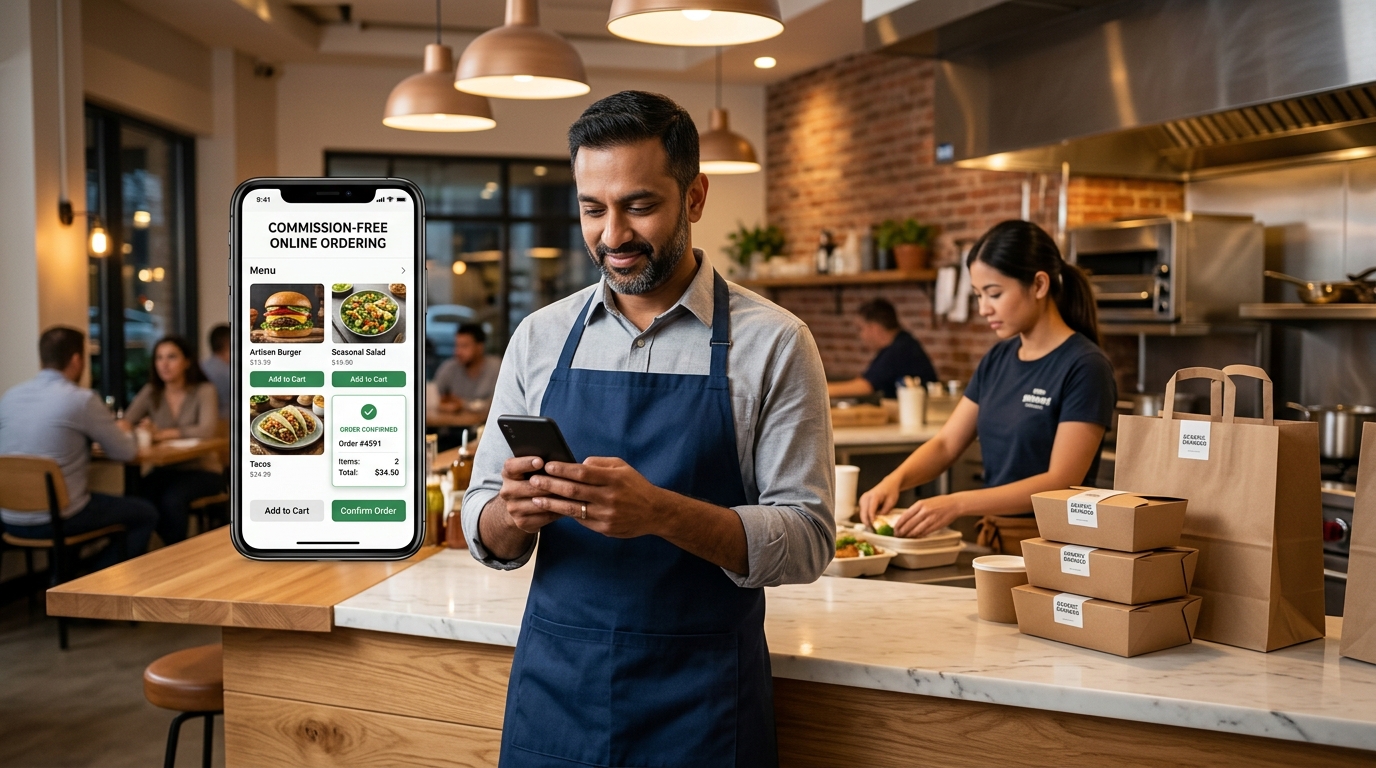
Commission-free online ordering lets customers place orders directly through a restaurant’s website or branded ordering platform without a marketplace commission on each transaction. The restaurant receives orders through its own channel rather than depending entirely on a third-party marketplace listing.
A direct ordering system can display the restaurant’s menu, prices, food photos, pickup options, delivery availability, and checkout process. Customers browse the menu, select their items, and submit an order without needing to find the restaurant through a delivery marketplace.
For example, a pizza restaurant can add an “Order Online” button to its website. A customer visits the site, chooses a pizza, adds sides, and checks out. The order goes through the restaurant’s ordering system, giving the business a direct sales channel.
Commission-free does not always mean completely free. Payment processors may charge transaction fees, and delivery providers may charge delivery fees. Restaurants should review the full pricing structure before choosing a platform.
The main advantage is control. A restaurant has a direct route for generating orders, promoting its menu, and encouraging customers to return.
Why Do Restaurants Want Their Own Ordering System Instead of Relying on DoorDash?
Restaurants want their own ordering systems because direct channels give them greater control over branding, customer relationships, promotions, and ordering costs. Third-party marketplaces still have value, but they do not need to be the only way customers order food.
DoorDash helps restaurants reach customers who are browsing its marketplace. That discovery can bring in new diners who would not otherwise know about the restaurant. However, marketplace delivery orders carry commissions based on the merchant’s selected plan.
According to DoorDash’s published US pricing, its Basic, Plus, and Premier marketplace plans charge 15%, 25%, and 30% commission on delivery orders, respectively. Pickup orders carry a 6% commission under the listed plans. These rates can change, so restaurant owners should verify current pricing before making a decision. <Cite refs={[“turn828592search0″,”turn828592search6”]}/>
A direct ordering channel gives restaurants another option. Instead of sending every customer to a marketplace, the restaurant can direct returning customers to its website or branded ordering app.
This approach creates a more balanced strategy. Marketplaces can help with customer discovery, while direct ordering helps the restaurant build repeat business through its own digital presence.
How Much Can Restaurants Save With Commission-Free Online Ordering?
Restaurants can estimate potential savings by comparing marketplace commissions with the payment processing and other costs associated with direct orders. The actual savings depend on order volume, average order value, delivery arrangements, and the platform’s pricing.
Consider a restaurant that receives $10,000 in monthly marketplace delivery orders. At a 25% commission rate, the marketplace commission would total $2,500 before accounting for food, labor, packaging, and other operating expenses.
A direct ordering system with no marketplace commission would avoid that specific $2,500 commission on those orders. The restaurant would still need to account for payment processing, delivery, software, marketing, and any other applicable charges.
Here is a simplified illustration:
These figures illustrate the commission alone, not total operating costs or guaranteed savings. They use the published DoorDash marketplace commission rates as examples. <Cite refs={[“turn828592search0″,”turn828592search6”]}/>
There is another important consideration: marketplace orders and direct orders do not always represent the same sales opportunity. A marketplace may introduce a restaurant to a new customer. Direct ordering is particularly valuable when a restaurant can encourage existing customers to order through its own channel.
The right comparison considers both customer acquisition and order profitability. Restaurant owners should calculate the net contribution from each channel rather than judging it by commission percentage alone.
What Are the Benefits of Owning Your Restaurant’s Online Ordering System?
Owning a direct ordering channel helps restaurants manage their brand, connect with customers, and encourage repeat purchases. It also gives the business a place to promote its menu without relying entirely on marketplace visibility.
1. Keep More Revenue From Direct Orders
Marketplace commissions take a percentage of each qualifying order. A direct ordering channel removes that marketplace commission when the chosen system charges none, leaving the restaurant with more revenue before its remaining expenses.
For a restaurant with frequent repeat orders, the financial impact can add up. Even a modest shift toward direct ordering can make a difference when the business has healthy margins and controls its other costs.
Restaurants should compare providers carefully. A commission-free offer can still include payment processing, delivery, or optional service fees. The best decision comes from reviewing the total cost per order.
2. Build Direct Customer Relationships
A restaurant’s website provides a direct connection between the business and its customers. Customers can learn about the menu, discover specials, review pickup instructions, and place their next order from the same channel.
Depending on the platform and customer consent, restaurants may use first-party customer information for order updates, loyalty programs, and relevant marketing. Privacy rules and applicable email or text messaging requirements still apply.
This relationship matters because repeat customers can become a valuable source of revenue. A restaurant that provides a good ordering experience has more opportunities to encourage another purchase without relying solely on marketplace promotions.
3. Control Your Brand and Menu Experience
A restaurant’s ordering website can reflect its own identity. The design, food photography, menu descriptions, colors, and promotions can match the restaurant’s brand.
A branded experience helps customers recognize the business and understand its offerings. Restaurants can highlight popular dishes, family meals, combo offers, catering options, and seasonal specials in a way that fits their audience.
Menu accuracy matters just as much as design. Prices, item availability, modifiers, allergen information, and pickup or delivery instructions should remain current. A clear menu reduces confusion and helps customers complete their orders.
4. Promote Repeat Orders Without Depending on Marketplace Visibility
A restaurant can promote its direct ordering link through its website, social media profiles, email campaigns, in-store signage, receipts, and permitted customer communications.
For example, a customer who picks up a meal can find the restaurant’s website on the receipt and use it for a future order. A restaurant can share a link to its ordering page in an Instagram profile or on its Google Business Profile website and ordering links, where supported.
These touchpoints make direct ordering easier to find. The restaurant can then measure how well its promotions generate website visits, completed orders, and repeat purchases.
5. Connect Online Ordering With Local SEO
A restaurant’s own website can attract customers who search Google for nearby restaurants, specific cuisines, and food delivery options. Local SEO helps the website and Google Business Profile appear for relevant searches.
Useful menu pages, accurate business information, mobile-friendly design, customer reviews, and location-relevant content all support a stronger online presence.
For example, a Thai restaurant in Connecticut can optimize its website around its cuisine, genuine service area, menu offerings, and pickup or delivery options. A prominent ordering button gives visitors a clear next step.
Local SEO does not guarantee rankings or orders. It helps the restaurant build a discoverable digital presence that supports direct sales over time.
Does Commission-Free Online Ordering Mean Restaurants Should Leave DoorDash?
No. Commission-free direct ordering and third-party marketplaces serve different purposes. Restaurants can use both channels to reach new customers and encourage repeat orders.
DoorDash can introduce a restaurant to diners who are exploring nearby food options. Its marketplace also provides delivery logistics and customer-facing features, depending on the plan and arrangement.
A restaurant’s own ordering system serves a different role. It provides a direct channel for customers who already know the business or discover it through the restaurant’s website, local search, social media, and other marketing efforts.
The stronger strategy depends on the restaurant’s goals. A new restaurant may value marketplace exposure while building its website traffic. An established restaurant with a loyal customer base may have more opportunities to move repeat orders toward direct channels.
Restaurant owners should compare sales, total fees, new-customer acquisition, repeat purchase rates, and order profitability across both channels. The objective is not to abandon every marketplace. It is to avoid depending on a single source of online orders.
What Should Restaurants Look for in an Online Ordering System?
Restaurants should evaluate an online ordering system based on its pricing, ease of use, menu management, payment options, order handling, delivery arrangements, and marketing capabilities. The system must fit the restaurant’s daily operations as well as its budget.
Start with the full fee structure. Confirm whether the provider charges a commission, monthly subscription, setup fee, payment processing fee, or per-order delivery charge. Check whether additional costs apply to branded apps, loyalty features, integrations, or marketing tools.
Next, examine the customer experience. The menu should work well on mobile devices, checkout should be straightforward, and customers should receive clear order confirmations. Staff need a reliable way to receive, review, and manage incoming orders.
Consider integrations with the restaurant’s point-of-sale system, kitchen workflow, and delivery arrangements. An ordering system that creates unnecessary manual work can slow down service during busy periods.
Finally, look at reporting and customer engagement. Restaurants benefit from understanding order volume, popular items, repeat purchases, and campaign performance. These insights help owners improve menus and marketing decisions.
How Can CoPixels Help Restaurants Grow Direct Online Orders?
CoPixels helps restaurants build and improve the digital channels that support direct ordering. Its restaurant marketing services include commission-free online ordering, branded apps, local SEO, and review growth. Its website design and development services help businesses create websites that make it easier for customers to discover services and take action. <Cite refs={[“turn828592search8”]}/>
For restaurants, the work starts with understanding the current ordering setup. Some businesses need a better mobile-friendly website. Others need a clearer ordering path, stronger local search visibility, or a branded app that supports repeat customers.
CoPixels can help restaurants connect their online ordering experience with website design, local search, social media, and digital marketing. The goal is to make direct ordering easy to find and simple to use.
The right solution depends on your restaurant’s size, menu, existing technology, and customer base. A focused strategy helps you choose the improvements that support your business goals instead of adding tools without a clear purpose.
Build a Direct Ordering Channel for Your Restaurant
Third-party delivery marketplaces can help restaurants reach new diners, but relying on them for every online order limits the business’s control over its ordering strategy. A direct ordering channel gives customers another way to buy from your restaurant and creates more opportunities to build repeat business.
Commission-free online ordering can reduce marketplace commission costs on eligible direct orders. A strong website, local SEO, clear menu, and effective customer communication help those orders happen.
CoPixels helps restaurants strengthen their online presence with direct ordering solutions, restaurant marketing, website development, and local SEO.
Ready to give customers a better way to order directly from your restaurant? Visit CoPixels to explore restaurant marketing and commission-free online ordering solutions.
Frequently Asked Questions
1. What is commission-free online ordering for restaurants?
Commission-free online ordering lets customers place orders through a restaurant’s own website or ordering channel without a marketplace commission on each order. Payment processing and other service fees may still apply.
2. Does DoorDash charge restaurants a commission on every order?
DoorDash charges commissions on marketplace orders according to the merchant’s plan. Its published US pricing lists 15%, 25%, and 30% commission rates for delivery orders across its Basic, Plus, and Premier plans. Direct Online Ordering has a different fee structure. <Cite refs={[“turn828592search0″,”turn828592search1”]}/>
3. Can restaurants use DoorDash and their own ordering system together?
Yes. Restaurants can use DoorDash for marketplace discovery and delivery options while promoting their own website or branded ordering channel for direct orders. The right balance depends on profitability and customer behavior.
4. Does commission-free online ordering help restaurants increase profits?
It can improve order profitability by removing marketplace commissions from eligible direct orders. Actual profit depends on payment processing, delivery, marketing, food costs, and whether the direct channel generates enough orders to justify its operating costs.
5. Can CoPixels help restaurants set up direct online ordering?
CoPixels offers restaurant marketing services that include commission-free online ordering, branded apps, local SEO, and review growth. Restaurants can discuss their existing website and ordering needs with the CoPixels team.